
Spanish holds the #2 spot for the most native speakers worldwide and is the official language of 21 countries. With an estimated 41 million native Spanish speakers in the U.S. alone, it’s no wonder so many people are trying to achieve at least some level of fluency.
Learning Spanish opens the door to communicating with a huge portion of the world and gives you a major edge professionally—even if you live in an English-speaking country.
So why do so many people never make real progress?
Some don’t get beyond their high school Spanish. Others study it through college only to find that, while they can hold a conversation, it still doesn’t feel fluent. And others still have no clue where to start.
So how do you learn fluent Spanish efficiently?
Let me share what worked for me.
My Humble Language Beginnings
I’m African American, born and raised in Kentucky, U.S.A. My parents, grandparents, and everyone I knew growing up were English speakers. I didn’t have a Spanish-speaking abuela I visited every summer. I didn’t study abroad. In fact, I didn’t travel internationally until I was 24.
But a few months later I could hold down conversations on topics that I was familiar with with relative ease. A couple of years later I had learned fluent Spanish and most native speakers that didn’t know me assumed that I was from a Spanish-speaking country and, of course, I had fun telling them that I was and making them guess for a little while.
By age 18 I was offered a position in a major hospital as a Spanish medical interpreter, and I spent the next 6 years interpreting for Spanish-speaking patients from a wide variety of countries in every sort of medical situation.
In college, I took Spanish electives just to get some easy credits (lazy bum, I know) and tested out of every single class with high marks.
In summary, I am not a native speaker. I was not all that young when I began learning (certainly way past the 4 or 5-years-of-age that they say is ideal to achieve native or near-native fluency). I never studied Spanish in college. Most importantly, I’m nothing special. Countless others have also discovered the secrets of efficient language acquisition. So how can you learn fluent Spanish quickly?
Here are my top 6 methods for learning fluent Spanish. Let me say that these methods are in no particular order. Do not feel like you need to master one before moving on to the next. You could easily do 10 minutes of each one for a total of 1 hour per day of study starting TODAY, and you’ll have so much fun with the variety that you won’t ever get bored.
For specific recommendations on resources for each one of these categories download my free quickstart guide to learning fluent Spanish.
1. Listen to Spanish music, audiobooks, podcasts, and radio

Many of us don’t have the opportunity to take off and leave to a foreign country with the sole purpose of learning the language. And trust me, you don’t have to. I have now lived in Mexico for over 5 years, however, I was fluent in Spanish long before that.
If you cannot immerse yourself in the language by natural means, then you must create your own immersion at home. One of the ways that you can do this is by creating opportunities to listen to Spanish pretty constantly.
Back when I had absolutely no intention of learning Spanish I remember that my dad, who was trying to learn Spanish, would always put Selena and other music in Spanish in the car while we drove. He would explain to me what some of the lyrics meant, but I was not interested at the time. I would mindlessly hum along to the music all the while wondering why I would ever need to learn Spanish.
Eventually, I started singing the songs, having absolutely no clue as to what I was saying. The funny thing is, about a year later, everything changed. I actually began to need to learn Spanish because my family had switched over to a Spanish speaking congregation in order to help with Bible community work there.
As I started actively learning vocabulary words and how to put phrases together, I found that some were so familiar! I had listened to and said those same words dozens of times…in the songs! So when I learned the meaning behind the words, I only had to hear it once, and BOOM! It just stuck because my brain and my tongue were already familiar with them.
I want you to do the same thing. Start out with slower songs in Spanish and progress to faster ones as long as you can clearly hear the syllables being pronounced.
I provide several recommended songs in my Quickstart Guide to Learning Spanish for Beginners, which you can download for free here.
Listening to books, especially children’s books, is also a great way to start out. I remember listening frequently to a book called Mi Libro de Historias Bíblicas (My Book of Bible Stories) over and over again in Spanish. The speaker talked clearly and relatively slowly, and these became easy for me to understand. Stores like Audible and Audiobooks are a great place to find Spanish audiobooks.
Don’t just listen to songs and stories once and move on to the next one. Again, think about how a baby learns a language. If you have babies or small children then you know how much they love for you to read the same story to them over and over again or how excited they get when they hear a familiar song. Just ask my toddler who is not content until I’ve sung The Itsy Bitsy Spider to her at least a dozen times in a row.
This may make you want to pull your hair out and you may not understand why they don’t want more variety. But babies know exactly what they’re doing. All this repetition plays a huge role in their learning of vocabulary words and studies have shown that they learn them faster when they hear the same thing over and over again as opposed to constantly listening to a new song or story. The predictability and familiarity helps children develop their language skills and it will do the same for you.
So pick a handful of nice songs and books and listen to the same ones…over and over. You’ll be surprised by how your brain begins to pick up on the rhythm, flow, and some of the words of the language.
Additionally, listening to podcasts and talk radio in Spanish adds an additional challenge to the mix. Hearing the question/answer style of interviews trains the brain in conversation. After all, a conversation is all about asking questions, listening to the answer, and responding to the questions asked to you.
2. Watch shows, movies, and the news in Spanish

Similar to listening to Spanish, throwing some visuals in there by watching shows, movies, and news in Spanish will go a long way toward your understanding of the language.
Back in the day, I learned a LOT from Destinos, the slow-paced Spanish telenovela, created specifically for beginning Spanish learners. The speech is clear, as are the gestures. Some found it corny. I found it fascinating.
Listen to the speakers and watch their body language. Recall that in order to teach a language it is not necessary for the teacher to speak the native language of the student. The student can learn the new language through complete immersion, and a big part of that learning usually comes from something called total physical response (TPR). This is the physical movement that goes along with a language.
An example would be if you meet a person from another country who just stepped off of a plane, you hold your hands out, smile, and say “Welcome!” Even if that person does not speak English, it’s pretty likely that they’ll know what you mean.
It’s true that unless you’re watching a program specifically designed for Spanish language learners, the actors are not actually trying to teach you Spanish and are usually not going to be using over-the-top TPR. But still, observing how the actors move on TV, not just what they say, will go a long way in boosting your understanding.
Watching the news in Spanish is also a great way to practice listening to Spanish. News anchors are trained to speak clearly and be easily understood. The B-roll footage will further reinforce your understanding of the content.
Turning on the subtitles in English or Spanish can also help eventually. But in the beginning, I highly recommend focusing primarily on what you can see and hear, not on what you can read.
3. Learn to Read Spanish in 1 day and read frequently
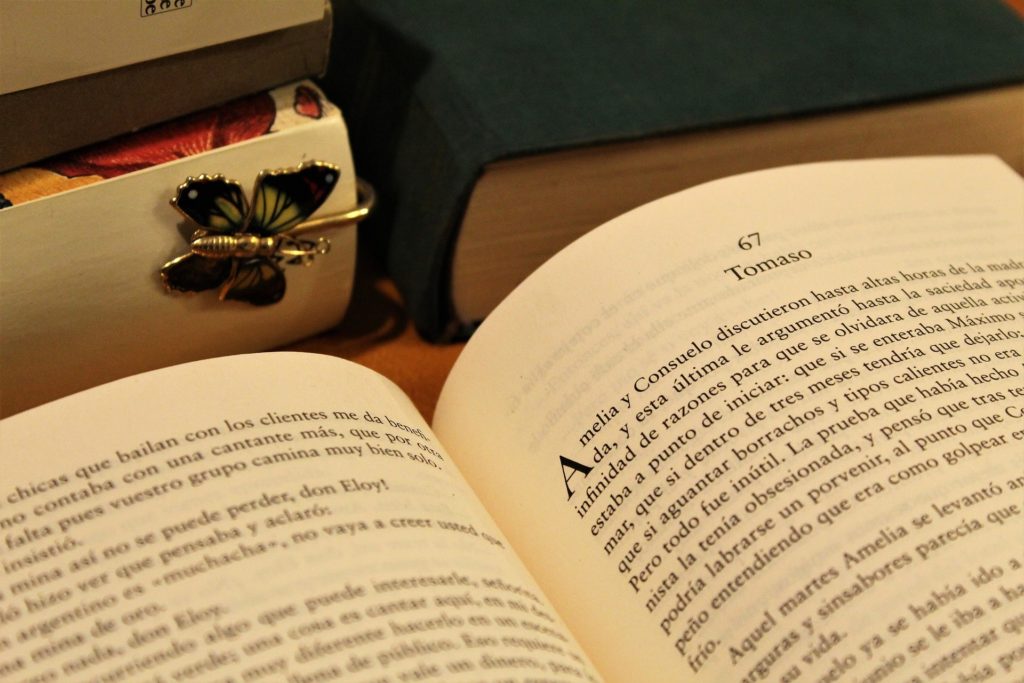
Yes, you read that correctly. I said go ahead and learn to read Spanish in ONE DAY. I did.
This is a tip I stole from my dad. Back in the day, he was the only member of my small family who had made an attempt at learning Spanish and therefore already spoke some when he began teaching me and my mom. He spent much of the day reading Spanish and he would tell mom and I that we needed to do the same every day in order to help us learn the language.
I was a bit skeptical at first as to how in the world a person can learn to read a language without knowing what they’re saying. But I soon (and by soon, I mean that day) discovered just how easy and beneficial it was. (P.S. – My mom and dad are now using this same method of reading out loud to learn Swahili and it’s working out amazing for them.)
Spanish is usually an incredibly easy language to learn to read for an English speaker because it shares the same alphabet with English, with the exception of the ñ, which doesn’t exist in English. Unlike English, there are only 24 possible phonemes (unique sounds) to make in Spanish versus the English 44.
Each vowel makes literally only one sound. Many consonants also only make one sound, although there are some exceptions. In the case of the letters that can make more than one sound, there are clearcut rules in place in order for you to know when to choose each sound.
Here’s a pro tip: Find a written passage for which you also have access to the audio. This can be an audiobook for which you also have the ebook to go with it or a transcript that you have to a video, etc…
Learn the Spanish pronunciation rules. This PDF guide here from gringoespañol.com is a good place to start: Click here.
Then start reading the passage according to these rules. Refer to the rule guide often. Give it your best go and then listen to the audio. Mark where you made mistakes and notice which pronunciation rules you were breaking when you made those mistakes. Do this many times until you can read the passage perfectly.
It does not….I repeat it does NOT matter if you do not know what you are saying. Take a moment and be impressed with yourself that you are reading a language with near fluency on Day 1. If you can read Spanish fluently then you can soon speak Spanish fluently.
Spend some time reading every single day and don’t forget to check your pronunciation regularly. This is important in order to not fall into bad pronunciation habits which are difficult to fix later. Your reading will improve, your pronunciation will improve, your brain will get used to speaking in Spanish, your ear will get used to hearing the Spanish, and you’ll be well on your way to fluency with just this one simple exercise.
4. Practice writing dictations

Now go ahead and start writing. For the same reasons that Spanish is an easy language to read it’s also very easy to write.
I had some natural practice with writing because within weeks of joining my new Spanish congregation, I was given Bible assignments that I had to prepare and present.
I didn’t have the language skills to just create an outline of what I wanted to say, so I had to write out every single word for a little while. The writing was based on the Bible and Bible-based publications that I had access to so I had the opportunity to write out how I thought things should be spelled and then double-check my work.
You can put this into practice yourself by using those same audios that you were listening to in order to check your reading. But now put the transcripts away and try to write them out yourself.
Before checking your work with the transcript, listen to the audio again and go back over what you wrote, referring to your pronunciation guide. Correct any mistakes you see and then go ahead and doublecheck with the transcript. Your confidence will grow when you see that, hey! Not only can you read Spanish now. You can also write it!
Sure, there are some tricky letters in Spanish. Sometimes you won’t know if a word has an “s” or a “c” or a “k” or a “c” but the more you read, the more you’ll pick up on all of those tricky words, which are few and far between when compared with English.
I must say that I am so glad I’m a native English speaker who learned Spanish and not the other way around because English seems like a nightmarish language to learn how to spell properly!
5. Begin talking with Spanish speakers
So you’ve laid a bit of groundwork and your tongue is getting used to a new language, as are your ears. Well, don’t delay any further in trying out your skills with Spanish speakers. In order to learn Spanish fluently, you must speak it with real people.
Now you may be one of those people who just flies into a conversation after you’ve been learning Spanish for 5 minutes (and if that is you, hats off to you! You’re going to be amazing!)
Or you may be like me. I am a natural introvert in my own language, so attempting to speak another one which I hadn’t been learning long was not the most thrilling thought in the world to me.
But again, I was completely surrounded by Spanish in my new congregation and in the Spanish community work that I was now a part of, so I had to speak.
You need to make yourself speak and there are a variety of ways in which you can do this.
You may have gracious Spanish-speaking workmates, schoolmates, or neighbors that will let you practice with them.
But if you aren’t that fortunate or you’re just too shy or uncomfortable trying out your Spanish with people that you know, then you can go online.
6. Include some formal study

You know I had to say it. If you’re interested in speaking Spanish properly, then some amount of formal study will be very helpful.
Most of my formal study was done in my middle and early high-school years because after that I was already fluent. But that formal study was a great compliment to all of these other methods that I was putting into place.
Why is some formal study so important? Well, there are many reasons. Here are a few:
- Following a study program will help teach your proper grammar. You don’t want to be that gringo forever using the infinitive form of the verb and saying things like “Joel ir al mercado.”
- Formal study helps you gauge your progress and you’ll feel good about seeing how far you’ve made it into the program and then completing it.
- Formal study helps to fill in any gaps that you may have from your informal study using the other methods that I’ve outlined above.
What do I mean by formal study? 4-6 years of college? Absolutely not! Studying a language in college can be helpful (especially if you have a study abroad program included) if that’s really where your interest is and you have the time, money, and inclination. But it’s completely unnecessary, and may even be an inhibitor to your learning if you think that earning your degree is an indicator of how you actually speak the language.
Fortunately, there are many other far less expensive, less time-consuming, and more flexible options.
Over the years there are three questions regarding Spanish that I’ve been asked the most.
- Where are you from…no, like really? (from native speakers)
- How did you learn Spanish
- How can I learn like that?
I’ve had no problem helping people to adopt methods 1-5 that I’ve described above, but when it came to 6, well, that was tough, especially when I was speaking to an adult. There are a lot of Spanish language learning programs out there, but I find that a lot fall short in crucial areas.
Some courses don’t give you any real means of seeing how you’re doing with pronunciation. You’re kind of winging it and hoping that you’ll be understood when you step into the real world.
Some put too much emphasis on grammar, reading, and writing, and the student is left finishing with perfect grades but hardly being able to speak a comprehensible word.
Most do not offer any cultural information around the language. Although this may seem unimportant, you’ll discover that culture and language are intertwined. The more in tune you are with the people who speak your target language the more you will relate to them and the easier it will be to learn their language.
And finally, some courses are just straight-up boring.
So eventually I created my own. My signature program, the Caminos Conversation Club, is an online Spanish learning community built around exactly what helped me and so many others become fluent.
Inside, you’ll get:
- Daily live conversation sessions for all levels
- Prep materials to help you build vocabulary and grammar in context
- A supportive, judgment-free community where it’s safe to make mistakes
- Real themes, real language, and real-life fluency building
Caminos gives you structure without stiffness and community without pressure. It’s not a textbook. It’s not a lecture. It’s a path forward.
So there you have it—my exact process, start to finish.
If you’re ready to begin your own Spanish journey, I’ve put together a FREE Spanish Conversation Blueprint. It’s a quick-start study guide to get you going and moving forward.
Drop your email below, download the PDF, and take that first step.
Happy learning,
Erica
So what about you? Where are you in your Spanish learning journey right now? What has been your biggest struggle? Let us know in the comments below!
Like this? PIN IT and follow me on Pinterest. 🙂



Erica Ray
Latest posts by Erica Ray (see all)
- Spanish Fluency Ecosystem for Life in Mexico - March 9, 2026
- The Spanish Imperfect Tense (essential for good storytelling!) - February 10, 2025
- Real Spanish Conversation: El Trabajo (Spanish Listening Practice for Intermediate/Advanced) - January 14, 2025
